 Plant
PlantAraceae · Morphology
Monstera deliciosa: why the leaves get holes
Monstera deliciosa
It is the single most googled question about the plant: why do the leaves get holes? The answer is neither poor care nor age alone, but a piece of controlled developmental biology that Monstera deliciosa shares with only a handful of other plants. And the name of the species carries a Danish imprint.
A Danish botanist and a holotype from Oaxaca
The scientific name Monstera deliciosa Liebm. was published in 1849 by the Danish botanist Frederik Michael Liebmann, in the journal of the Danish Natural History Society in Copenhagen (Liebmann 1849). The holotype, the single specimen the name is tied to for good, was collected by Liebmann himself in December 1842 in the mountains of Oaxaca in southern Mexico (POWO).
That place matches the species’ natural range. According to Plants of the World Online, the original range runs from southern Mexico (Veracruz, Oaxaca, Chiapas) to Guatemala, in humid tropical forest in the lowlands and lower mountains (POWO). The species belongs to the genus Monstera in the arum family Araceae, a large tropical family known for spadix inflorescences and for needle-shaped calcium oxalate crystals (raphides) in the tissue.
Those raphides make the unripe fruit strongly irritating. The ripe infructescence, by contrast, is edible and sweetly fragrant, and it is this that the epithet deliciosa refers to (POWO). The genus name Monstera is traditionally linked to the large, almost monstrous perforated leaves, though that reading is more tradition than documentation.
Some of the confusion around the name has historical roots. Juvenile plants were long grown and traded under other genera, among them Philodendron pertusum Kunth & C.D.Bouché and Philodendron fenestratum Linden. Both are today accepted synonyms of Monstera deliciosa (GBIF), but the mix-up with true Philodendron persisted in the horticultural trade for decades. In English the species is still most often called the Swiss cheese plant, after those holes, or the window leaf. From its origin the plant has since spread throughout the tropical and subtropical world as an ornamental and now occurs locally naturalised outside its native range (POWO). That a shade plant from a Mexican rainforest has ended up on windowsills across the globe does not change the fact that its biology was shaped somewhere quite different. Both the way it climbs and the famous holes make sense only there.
From forest floor to canopy: a climber that seeks the dark
Monstera deliciosa is a secondary hemiepiphyte (Muir 2013). The seed germinates on the forest floor, and the plant climbs a host trunk with aerial roots until it reaches the brighter canopy. The journey up begins with an unusual behaviour.
In the closely related Monstera gigantea, Donald Strong and Thomas Ray showed in 1975 that seedlings grow toward the darkest part of the horizon rather than toward the light. They named the response skototropism, growth toward darkness (Strong & Ray 1975). In the forest the darkest direction is almost always a tree trunk, so skototropism leads the seedling straight to a potential host. In their experiments the seedlings oriented toward the darkest sector of the horizon, exactly where a trunk would stand. The authors noted that the usual term “negative phototropism” is imprecise here: only growth toward the dark, not merely away from light, can guide the vine to a tree (Strong & Ray 1975). The experiment was done on another species in the genus, but it describes the growth form M. deliciosa shares with its relatives.
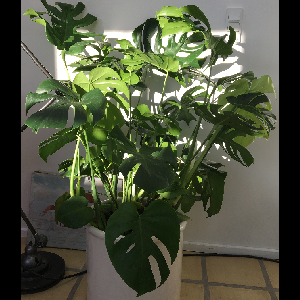
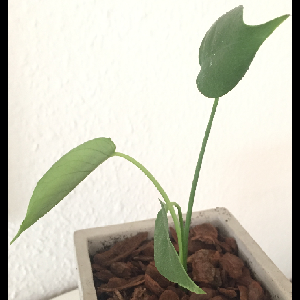
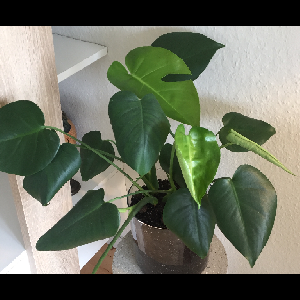
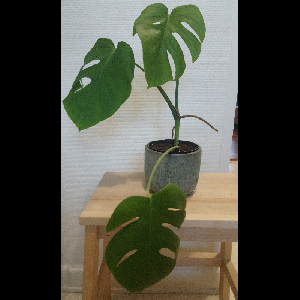
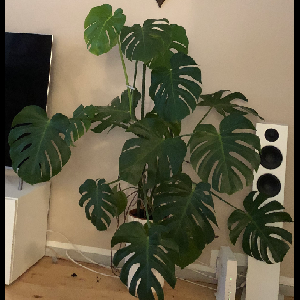
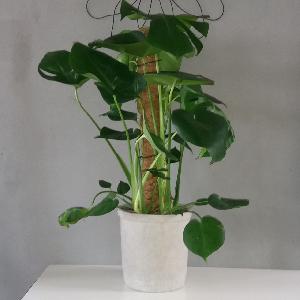
Only once the plant has found its trunk and begun to climb do the leaves change character. A juvenile plant’s leaves are small and entire, while the large, lobed and perforated leaves belong to the adult, climbing phase higher up toward the light.
The holes: programmed cell death, not random damage
The fenestrae, the holes inside the leaf blade, and the deep incisions from the leaf margin are neither tears nor damage. They are laid down early in leaf development through programmed cell death. In a detailed study of Monstera obliqua, Arunika Gunawardena and colleagues showed that a defined group of cells at the site of the future hole die at the same time, while the neighbouring cells carry on undisturbed. Cleavage of DNA in the nuclei is one of the earliest events, the cell walls are not broken down, and the process runs in synchrony across the whole hole (Gunawardena et al. 2005). The plant, in other words, shapes its leaf by actively killing cells rather than simply not forming them.
The phenomenon is rare in the plant kingdom. Perforating the leaf blade by killing off defined groups of cells is known only from a few monocots, among them species of Monstera and other aroids, and the distantly related Madagascar lace plant Aponogeton madagascariensis (Gunawardena et al. 2005). That such separate lineages have arrived at the same solution points to convergent evolution: the same developmental mechanism, arising independently more than once.
How the holes form is therefore well described. Why they are an advantage is a more open question, but not one without an answer. The best-supported explanation is Christopher Muir’s growth-variance hypothesis (Muir 2013). On the forest floor light arrives as scattered, moving sunflecks, and these brief flashes make up a large part of the plant’s daily carbon gain. A perforated blade can cover a larger area with the same amount of leaf tissue: the holes let light pass down to lower leaves, while the remaining tissue still catches the flecks that hit it. Muir’s model shows that this reduces the day-to-day variance in light capture and thereby raises the plant’s geometric mean fitness (Muir 2013).
It is a mathematical model, not a final proof, and contributions such as thermal regulation and resistance to wind gusts have also been proposed. But the growth-variance hypothesis explains a striking pattern: fenestration appears precisely in climbing understory plants that live on sunflecks, and not in plants in full, even light. The holes that a houseplant owner waits for as a sign of health are, in other words, an adaptation from the rainforest understory, not an ornament the plant invented for its own sake.
Sources
- Liebmann, F. M. (1849). Monstera deliciosa. Videnskabelige Meddelelser fra Dansk Naturhistorisk Forening i Kjøbenhavn 1849: 19. Via World Flora Online: https://www.worldfloraonline.org/taxon/wfo-0000245734
- Plants of the World Online (POWO), Kew. Monstera deliciosa Liebm. https://powo.science.kew.org/taxon/urn:lsid:ipni.org:names:87478-1
- GBIF Secretariat. Monstera deliciosa Liebm. GBIF Backbone Taxonomy. https://www.gbif.org/species/2868241
- Strong, D. R. & Ray, T. S. (1975). Host tree location behavior of a tropical vine (Monstera gigantea) by skototropism. Science 190(4216): 804-806. https://www.science.org/doi/10.1126/science.190.4216.804
- Gunawardena, A. H. L. A. N. et al. (2005). Programmed cell death and leaf morphogenesis in Monstera obliqua (Araceae). Planta. https://pubmed.ncbi.nlm.nih.gov/15931501/
- Muir, C. D. (2013). How did the Swiss cheese plant get its holes? The American Naturalist 181(2). https://www.zoology.ubc.ca/files/Muir_2013.pdf
Photos
In the app