 Plant
PlantStrelitziaceae · Ecology
Strelitzia reginae: the flower pollinated by birds' feet
Strelitzia reginae
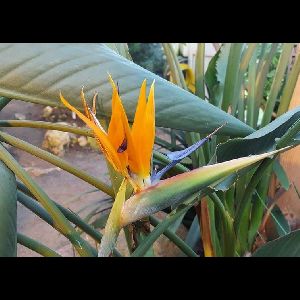
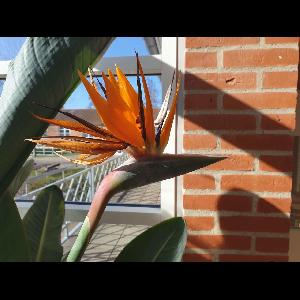
In English it is called the bird of paradise, after the bird-like shape of the flower: a horizontal, pointed spathe holds a fan of orange and blue petals, so that the whole thing resembles a bird’s head with a beak. But Strelitzia reginae is tied to birds in a far more concrete way than mere resemblance. It uses them for pollination, it does so with a trick that is nearly unique in the plant kingdom, and at the same time it hides a pigment in its seeds that is otherwise known only from animals.
The flower as a perch: pollination by the feet
In its South African homeland Strelitzia reginae is pollinated by sunbirds (Nectariniidae). The flower is built as a perch for exactly these birds. The blue petals are partly fused into an arrow-shaped structure that juts out horizontally, and this is where the bird lands to reach the nectar at the base of the flower. Under the bird’s weight the structure folds open and exposes the stamens hidden inside. The pollen is deposited not on the bird’s head or beak but on its feet, and is carried to the stigma at the next flower (Oxford Plants 400). This foot pollination is, as far as is known, nearly unique: Strelitzia is regarded as the only plant genus pollinated by the feet of birds.
Looking more closely at a single flower, it consists of three orange sepals and three blue petals. Two of the blue petals are fused into the arrow the bird sits on, which conceals both the stamens and the style. It is an unusual division of labour: the brightly coloured sepals provide the signal, while the fused petals have become a precise mechanical tool.
The flower carries all the marks of what botanists call the bird-pollination syndrome: strong red and orange colours, which birds see well, no scent, which birds do not need, and copious, dilute nectar deep in the flower. An important difference between the African sunbirds and the American hummingbirds is that sunbirds perch rather than hover. This is why sunbird-pollinated flowers such as Strelitzia have a solid perch, while hummingbird flowers typically hang free with nothing to land on.
The mechanism is precise and weight-triggered, not random. The flower opens only when something of the right weight lands in the right place, and that ensures the pollen ends up on a pollinator rather than being scattered. The flowers also sit several together in the horizontal spathe and open one at a time over several days, so a bird has reason to return. That the species is also efficiently pollinated by birds outside South Africa, where it is grown, shows how robust the system is (South African Journal of Botany 2010).
Bilirubin: an animal pigment in a plant
The strong colours are not only for show. In 2010 a research team led by Cary Pirone found something unexpected in Strelitzia reginae: bilirubin (Pirone et al. 2010). Bilirubin is a yellow-orange pigment most people know from animals, where it forms in the breakdown of haemoglobin and produces the yellow of bruises and jaundice. It had never before been demonstrated as a pigment in a plant.
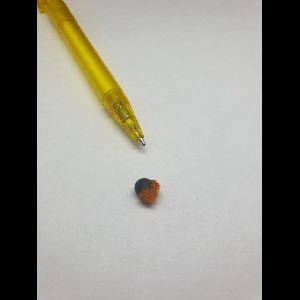
The pigment turned out to be the main colourant of the species’ orange seed arils, with smaller amounts in the sepals. Bilirubin belongs to the group of tetrapyrroles, otherwise known from chlorophyll and from the oxygen transport of blood, but unlike them bilirubin here produces a visible display colour. Until then no tetrapyrroles were known to generate display colour in plants, which is why the find was more than a curiosity (Pirone et al. 2010).
The researchers identified the pigment with liquid chromatography and mass spectrometry, and could thereby rule out that it was merely a related compound. The discovery added Strelitzia to the short list of cases in which the boundary between the chemistry of plants and animals turns out to be more permeable than textbooks long assumed.
Each colour has its own function. The intense blue of the petals is produced by a mechanism different from the orange aril, and the aril itself sits as a bright, strongly coloured tuft on the otherwise dark seed. That is no accident: a conspicuous coating is a classic signal to birds that there is something edible here, and the birds in return disperse the seeds. Bilirubin has since been found in several plant species, but Strelitzia reginae was the first, and the orange coating around the seed is still the textbook example. A flower that resembles a bird turned out, in the end, to share a pigment with the animals too.
From South Africa’s riverbanks, named after a queen
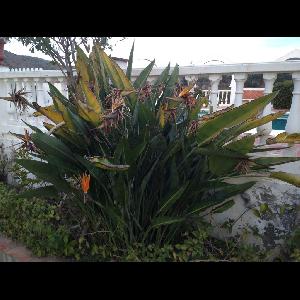
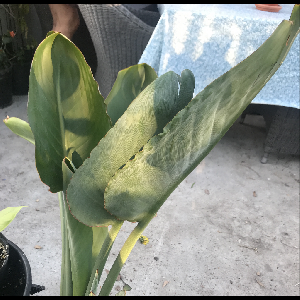
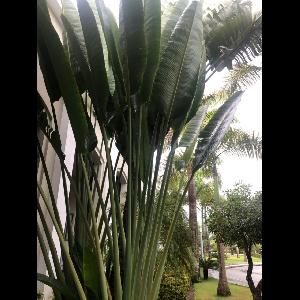
Strelitzia reginae Banks belongs to the family Strelitziaceae and to the genus Strelitzia, a small group of perennial, stemless to tree-like plants from southern Africa, among them the tall Strelitzia nicolai with white flowers. The family belongs to the order Zingiberales, the same as the bananas, and the relationship shows in the large, paddle-shaped leaves that sit in a fan from the base. Strelitzia reginae forms no real trunk but grows in dense clumps, and it is slow: from seed it can take several years before it flowers.
The species is native to eastern South Africa, in the Eastern Cape, where it grows along riverbanks and in coastal scrub. From there it has since spread to warm regions across the world and is today among the most recognisable ornamentals of all, not least as a cut flower, because the stiff stalks last a long time.
The genus holds only a handful of species, and Strelitzia reginae is by far the most widely grown of them. In South Africa the plant is a well-known symbol, and internationally it has become one of the fixed icons of the flower trade. Behind that status, however, lies a species whose biology is finely tuned to a particular interplay with particular birds in a particular landscape, and which flowers freely only when it gets enough light and warmth.
The name carries a piece of European court history. Both the genus name Strelitzia and the species epithet reginae, “of the queen”, honour Queen Charlotte of Mecklenburg-Strelitz, wife of the British king George III. The species was described in 1789 in Hortus Kewensis, William Aiton’s work on the plants of Kew, where Sir Joseph Banks was the leading figure, and the name is attributed to Banks. The plant one buys in a pot is the same whose flower, in the wild, opens under the weight of a sunbird, dusts pollen on its feet and hides an animal pigment in its seeds. Few houseplants carry so much unusual biology in a form most people see only as decoration.
Sources
- Oxford University Plants 400: Strelitzia reginae. https://herbaria.plants.ox.ac.uk/bol/plants400/Profiles/st/Strelitzia
- Efficient avian pollination of Strelitzia reginae outside of South Africa (2010). South African Journal of Botany. https://www.sciencedirect.com/science/article/pii/S0254629910002462
- Pirone, C. et al. (2010). The Animal Pigment Bilirubin Identified in Strelitzia reginae, the Bird of Paradise Flower. HortScience 45(9). Coverage: https://phys.org/news/2010-09-discovery-bilirubin.html
- GBIF Secretariat. Strelitzia reginae Banks. GBIF Backbone Taxonomy. https://www.gbif.org/species/2763116
- Plants of the World Online (POWO), Kew. Strelitzia reginae Banks. https://powo.science.kew.org/
Photos
In the app